When parents separate, many sort out arrangements for their children between themselves, without a judge being involved. Where that is not possible and one parent is thinking about applying to the family court, the first step is usually a MIAMA MIAM is a first meeting with a trained mediator, on your own, to talk about whether mediation could help sort things out without a court hearing. Most people have to attend one before applying to court, unless an exemption applies. (a first meeting with a mediator). This guide explains what it is, what happens at one, and when it is not needed.
What a MIAM is
MIAM stands for Mediation Information and Assessment Meeting. It is a meeting with an authorised family mediator, who is trained, neutral and does not take sides. Mediation means a series of meetings where a mediator helps both parents talk through the practical arrangements for the children and try to find a way forward they can both live with.
The MIAM comes before any of that. It is there so that both parents have at least considered reaching agreement before asking a court to step in.
Why it comes before a court application
In England and Wales, section 10 of the Children and Families Act 2014 says that before making most family applications, including an application about where a child lives or the time they spend with each parent, the person applying must attend a MIAM. The Family Procedure Rules set out the exemptions.
The application itself is usually made on a C100 (the court form used to apply for an order about children). The C100 asks you to confirm that you have attended a MIAM, or to say which exemption applies.
What happens at the meeting
A MIAM is a short meeting, in person or online. Parents can attend a MIAM together or separately. At the meeting the mediator will usually:
- explain what mediation is and how it works
- ask about your situation and what you are hoping to sort out
- check whether there are any safety concerns
- talk through other ways of reaching agreement
- assess whether mediation looks suitable
If you attended a MIAM, the authorised family mediator (accredited by the Family Mediation Council) who held it completes and signs the MIAM section of the C100 to confirm that you attended. This applies only where a MIAM was attended. If you are relying on an exemption instead, the C100 asks you to say which one applies.
Help with the cost
The Family Mediation Voucher Scheme provides a contribution of up to £500 towards mediation costs for eligible cases. A few things to know about it:
- it does not cover the cost of the MIAM itself, only the mediation sessions after it
- vouchers are allocated per case, not per person
- the scheme is time-limited, and vouchers are offered until they run out
The mediator will discuss the voucher with you at the MIAM if your case might be eligible. If you or the other parent are eligible for legal aid, the MIAM may be free with a mediator who does legal aid work.
When a MIAM is not needed
A MIAM is not required in every case. The exemptions include situations where:
- there is evidence of domestic abuse
- there are concerns about a child's safety
- the application is urgent
- you have attended a MIAM or mediation recently about the same issue
The full list of exemptions, and the evidence each one needs, is in the C100 form and its guidance. If you are in immediate danger, call 999. If you are worried about a child's safety, you can contact your local council's children's services or the police.
Getting ready for a MIAM
It can help to note down a few things beforehand:
- the arrangements you are hoping for, in plain words
- the dates and events that matter, such as when the current arrangements started
- any questions you want to ask the mediator
You can find an authorised family mediator through the Family Mediation Council.
Common questions
What does MIAM stand for?
MIAM stands for Mediation Information and Assessment Meeting. It is a first meeting with a family mediator, usually on your own, to find out whether mediation could help you and the other parent sort out arrangements for your children without a court hearing.
Do I have to attend a MIAM before applying to court?
In most cases, yes. Before making most applications to the family court about children, you are expected to show that you have attended a MIAM. There are exemptions, for example where there is evidence of domestic abuse, where there are concerns about a child's safety, or where the application is urgent.
Does going to a MIAM mean I have to go to mediation?
No. The MIAM is about information and assessment. The mediator explains how mediation works and whether it looks suitable for your situation. Whether mediation goes ahead afterwards depends on the mediator's assessment and on both parents.
Is there help with the cost?
The Family Mediation Voucher Scheme provides a contribution of up to £500 towards mediation costs for eligible cases. It does not cover the cost of the MIAM itself, only the mediation sessions afterwards. Vouchers are allocated per case, not per person, and the scheme is time-limited, so check the current position on GOV.UK. The mediator will discuss the voucher with you at the MIAM if your case might be eligible.
Sources
- GOV.UK, Making child arrangements if you divorce or separate
- GOV.UK, Family Mediation Voucher Scheme
- legislation.gov.uk, Children and Families Act 2014, section 10
- GOV.UK, Apply for a court order to make arrangements for a child (C100)
How familycourt.app and McKenzie can help
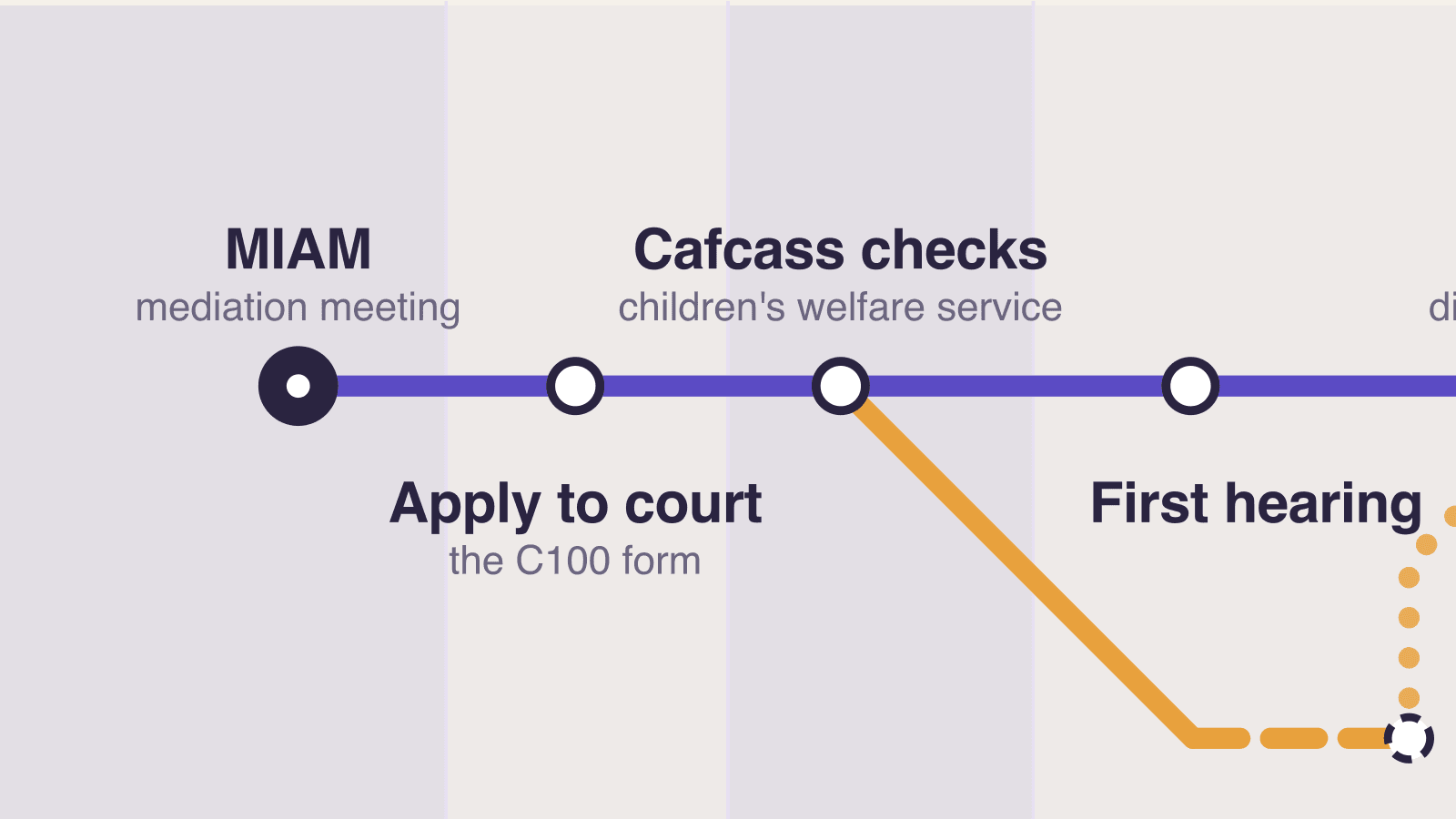
The case map shows where the MIAM sits in your process, before the C100 and the first hearing, and what typically happens next. McKenzie, the app's AI assistant, explains the MIAM exemptions and the C100's MIAM section in plain English, and Document Studio helps you prepare your own chronology of the dates and events that matter before you meet the mediator.