Cases are getting faster. The courts are getting busier. And for the first time, more than half of parents in private law children cases are in court with no lawyer on either side. Here is what the latest official numbers say, in plain English. The data runs to June 2026 and comes from the Ministry of Justice, Cafcass and the National Audit Office.
Who this is for. Parents and others representing themselves in the family courts of England and Wales. Scotland and Northern Ireland have different systems. This article explains the process and the numbers. It is not legal advice, and no one can tell you how long your own case will take or how it will end.
How long does family court take?
For a private law children case (the kind that starts with a C100A C100 is the form you fill in to ask the family court to make a decision about arrangements for a child. Once the court issues it, your case has a number and a first hearing is normally listed. form and ends with a child arrangements order), the average time from application to the case being closed was 33 weeks in April to June 2026. Just over half of cases (52%) finished within 26 weeks.
That is a real improvement. In 2023 the average reached 45 weeks, the longest on record. The fall since then is the result of more sitting days, the Public Law Outline relaunch freeing up capacity, and the Pathfinder courts, which we come to below.
Two things to keep in mind when you read that chart. An average hides a long tail: at the end of June 2026, 1,672 private law cases had been open for 100 weeks or more. And where you live matters a great deal, which is the subject of the postcode section below.
Why the courts are getting busier
The improvement in speed is happening while demand climbs. In 2025, parents and carers started 55,311 private law children cases, up 7% on 2024 and the steepest annual rise in a decade. The first half of 2026 was up again: April to June alone saw 14,833 new cases, 11% more than the same quarter a year earlier.
When more cases come in than go out, the pile grows. In April to June 2026 the family courts took on 14,833 new private law cases and closed 10,685. At that rate the open caseload grows by roughly 4,000 cases a quarter. It stood at 41,637 at the end of June, up from 36,571 a year earlier.
CafcassCafcass is the Children and Family Court Advisory and Support Service. It is independent of the court and of both parents, and its job is to advise the court about what is best for a child. is the service that advises the court on children's welfare in England; Cafcass Cymru does the same in Wales. It reported 29,150 open children's cases in June 2026, up 6.8% in a year.
Going to court without a lawyer
This is the number that matters most if you are reading this at the kitchen table at 11pm. In April to June 2026, 51% of private law cases ended with neither party represented by a lawyer. Only 13% had lawyers on both sides. Before the legal aid cuts of April 2013 (the LASPO Act), the neither-represented figure was about 13%.
In other words, going to family court without a solicitor is now the normal experience, not the exception. The courts are designed around lawyers, but most of the people in them do not have one.
Legal aid is still available for some family cases, mainly where there is evidence of domestic abuse or child abuse. Through that route, 9,867 applications were granted in 2025-26, and 83% of such applications were granted in April to June 2026. But finding a legal aid solicitor is harder every year. The number of family legal aid offices fell from 2,401 in 2011-12 to 1,125 in 2020-21, and a 2026 LexisNexis report estimates that 4.2 million people now live in areas with little or no family legal aid provision.
The postcode gap and Child Focused Courts
National averages hide a gap that is hard to believe until you see it. In December 2024, a private law case took an average of 70 weeks in London and 18 weeks in Wales. Same law, same forms, same type of case.
Wales is fast for a reason. It was one of the first areas to use the Pathfinder model, now renamed Child Focused Courts. Instead of a series of adversarial hearings, a Pathfinder court front-loads the work: Cafcass speaks to the child and both parents before the first hearing, agencies such as the police and local authority share information early, and the judge sees a fuller picture from the start.
The results reported by the Ministry of Justice in October 2026: average time from application to final order fell by close to half across the pilot areas. In North Wales it went from 33 weeks to 18. In Bournemouth and Dorset, from 51 weeks to 20.
What happens during those 33 weeks
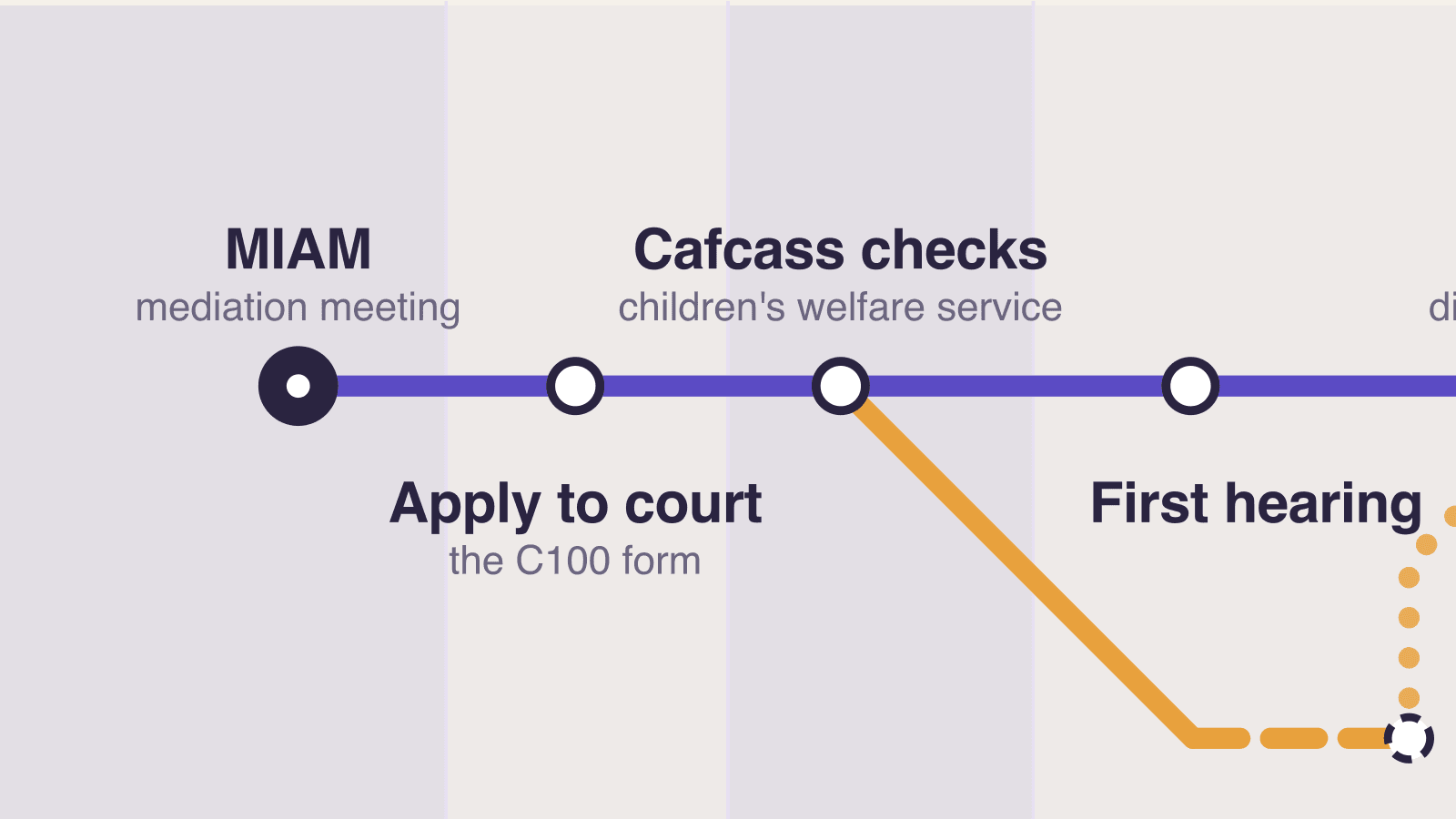
An average is easier to live with when you know what fills it. A private law children case in a standard (non-Pathfinder) court usually moves through these stages. The timings vary from court to court and case to case.
| Stage | What it is |
|---|---|
| MIAMA MIAM is a first meeting with a trained mediator, on your own, to talk about whether mediation could help sort things out without a court hearing. Most people have to attend one before applying to court, unless an exemption applies. | A meeting with a mediator before you apply, unless an exemption applies (for example, domestic abuse) |
| C100 application | The form and £270 fee go to the court. Cafcass runs safeguarding checks with the police and local authority |
| FHDRAA FHDRA is the first hearing in a children case: a first hearing and dispute resolution appointment. The court looks at what is agreed, what is not, and what needs to happen next. | First Hearing Dispute Resolution Appointment. The first time you are in front of a judge or magistrates |
| section 7 reportA section 7 report is a welfare report about what is best for a child, written for the court by Cafcass or the local authority when the court asks for one. It makes recommendations; the decision stays with the court. | If ordered, Cafcass or the local authority speak to the child and both parents and write a welfare report |
| DRAA DRA is a dispute resolution appointment: a hearing later in the case that looks at whether things can be settled now the reports and statements are in. If everything is agreed there, an order can be made at that hearing. | Dispute Resolution Appointment. Many cases settle here once the report is in |
| Final hearing | Evidence, statements and a decision, if the case has not settled |
Where the weeks go is mostly in the gaps: waiting for a hearing slot, waiting for a report, and adjournments when something is not ready. Being organised for each stage does not change the court's diary, but it does mean your case is not the one that gets adjourned because a statement was missing.
Domestic abuse orders
Applications for non-molestation and occupation orders (the two main protective orders in the family court) reached a record 36,376 in 2025. There is no court fee for these applications. Around 82% are non-molestation orders, and the court made 37,410 orders in the year.
Since July 2022, a person accused of abuse cannot cross-examine the other party in person; the court appoints a Qualified Legal Representative to do it instead. This is one of the areas where published data is thin. The Ministry of Justice does not release regular figures on how many QLRs are appointed, and legal commentators have described uptake as running at a few hundred cases against tens of thousands of cases that raise abuse allegations.
Divorce and money
There were 109,184 divorce applications in 2025, almost unchanged on the year. Since no-fault divorce arrived in April 2022, 73% of applications have been made by one spouse and 27% jointly. The joint share is creeping up.
How long does a divorce take? The law sets a floor of 26 weeks: 20 weeks from application to conditional order, then 6 more weeks to the final order. In practice the median case takes about 40 weeks to final order. Joint applications are faster (49 weeks on average to final order) than sole applications (60 weeks), mostly because there is no one waiting to be served.
Money is a separate case from the divorce itself. Financial remedy applications rose 8% to 49,067 in 2025, and about three-quarters of them are consent orders where the couple have already agreed. The government's consultation, A fairer end to relationships (June to August 2026), proposed rewriting the rules on how assets are divided and giving cohabiting couples financial rights for the first time. No law has been introduced yet, so for now the 1973 Act still applies.
Care proceedings and the 26-week limit
Public law cases are the ones a local authority brings when it has concerns about a child's safety. Since 2014 the law has said these should finish within 26 weeks. That target has never been met nationally. In April to June 2026 the average care case took 37 weeks and 36% finished inside the limit.
The wider picture: 81,770 children were looked after by local authorities in England at March 2025, down slightly from the 2023 peak. Adoption orders have fallen by about 43% since 2014, to 3,835 in 2025, while special guardianship orders (usually to a grandparent or other relative) now make up 61% of permanence orders.
What family court costs in 2026
Court fees rose in July 2026. These are the fees you pay the court. Solicitors' fees, if you use one, are on top.
| Application | Form | Fee from July 2026 | Previously |
|---|---|---|---|
| Child arrangements, prohibited steps or specific issue order | C100 | £270 | £263 |
| Divorce or dissolution | D8 (online) | £628 | £612 |
| Financial order (contested) | Form A | £321 | £313 |
| Consent order (agreed finances) | Form A / D81 | £62 | £60 |
| Non-molestation or occupation order | FL401 | No fee | No fee |
Help with Fees. If you are on a low income or have little in savings, you can apply for the fee to be reduced or waived using form EX160 (or online). Full remission is available to a single applicant with savings below about £4,250 and gross monthly income below about £1,420, with allowances for children. The thresholds are updated from time to time, so check the current figures on GOV.UK before you apply.
Mediation vouchers. The Family Mediation Voucher Scheme gives up to £500 towards mediation about children. 57,335 vouchers have been issued since 2021, and the scheme has been extended to March 2027. In the first group of about 7,000 families, more than two-thirds reached an agreement without going to court.
Solicitors' costs. There is no official average. Fixed fees for an uncontested divorce are commonly quoted at £500 to £1,000 plus VAT. For contested children or finance cases, costs of £5,000 to £10,000 per party up to the first main hearing are common, and fully contested cases can run well beyond £15,000. Treat these as indicative ranges from firms' own published guides. We have mapped these costs stop by stop, with 2026 hourly rates and a cost estimator, in What a solicitor and a barrister cost at every stage of a family court case.
What is changing, 2026 to 2029
- January 2025. Open reporting becomes permanent: accredited journalists and legal bloggers can report on most family cases, with anonymity for families.
- April 2026. Sir Andrew McFarlane retires as President of the Family Division, calling the Child Focused Courts rollout the biggest change to family courts in 30 years.
- June to August 2026. Government consultation on financial remedies on divorce and on rights for cohabiting couples. New law is unlikely before 2027-28.
- July 2026. Court fees rise: C100 to £270, divorce to £628.
- September 2026. MoJ starts publishing case timeliness by local court area and reinstates counts of children in private law cases.
- November 2026. Child Focused Courts open in eight more areas, from Coventry to Northumbria. £17m is allocated for 2026-27.
- January 2027. Leicestershire, Lincolnshire and Cambridgeshire follow.
- March 2027. Current end date of the Family Mediation Voucher Scheme.
- By March 2029. Child Focused Courts in every area of England and Wales, subject to funding for the final 21 areas.
Set against that, the budget for family court sitting days is planned to fall from 97,300 in 2025-26 to 93,100 in 2028-29, a cut of about 4%, while demand is rising at 7% to 11% a year. Whether case lengths keep falling depends on whether Child Focused Courts deliver at national scale what they delivered in the pilots.
Where this is heading
No government body publishes a demand forecast for the family courts; the National Audit Office criticised that gap in 2025. The table below is our own extrapolation from the trends above, with the assumptions stated. It is a guide to the direction of travel, not a prediction about any individual case.
| Measure | 2025 actual | 2026 (est.) | 2027 (est.) | Assumption |
|---|---|---|---|---|
| Private law cases started | 55,311 | 60,000 to 61,500 | 62,000 to 66,000 | Growth slows from 7 to 11% to 3 to 7% |
| Open private law cases (June) | 36,571 | 41,637 (actual) | 44,000 to 47,500 | Inflow slows as Child Focused Courts lift disposals |
| Average private law case length | 37 weeks | 33 to 34 weeks | 32 to 36 weeks | Pilot gains offset by rising backlog and fewer sitting days |
| Cases with no lawyer on either side | 47% | 50 to 51% | 51 to 54% | Recent trend of about 3 points a year, flattening |
| Divorce applications | 109,184 | 105,000 to 108,000 | 104,000 to 108,000 | First half of 2026 down 3 to 5% |
| Care cases within 26 weeks | 38% | 36 to 40% | 38 to 42% | Gradual Public Law Outline improvement |
Put simply: more cases, fewer sitting days, and more parents without lawyers. The speed-up of the last two years is real, but it is being asked to absorb a lot. The reasonable planning assumption for a parent starting a case in late 2026 in a standard court is still eight to twelve months, and considerably less in a Child Focused Court area.
Questions parents ask
How long does family court take in 2026?
The average private law children case took 33 weeks from application to disposal in April to June 2026, and 52% of cases finished within 26 weeks. London has been much slower than this average and Wales much faster. Care proceedings averaged 37 weeks.
How long after submitting a C100 is the first hearing?
There is no published national figure for the wait to the first hearing (the FHDRA). After the C100 is issued, Cafcass carries out safeguarding checks and sends a letter to the court before the first hearing. The wait depends heavily on the court's diary in your area. The new area-level timeliness data from MoJ is the best place to see how your court compares.
Do I need a solicitor for family court?
There is no requirement to have one. In April to June 2026, 51% of private law cases had no lawyer on either side and only 13% had lawyers on both sides. Many parents represent themselves, sometimes with a McKenzie friend (a trained, non-lawyer supporter who can sit with you in court but cannot speak for you or give legal advice). Whether a solicitor is right for you depends on your circumstances and what you can afford.
How much does family court cost?
The court fee for a C100 application is £270 and for a divorce £628 (July 2026). Non-molestation order applications are free. Help with Fees can reduce or waive court fees if you are on a low income. Solicitors' fees are separate and vary widely.
Can I get legal aid for a family case?
Legal aid for private family cases is mostly limited to people with evidence of domestic abuse or child abuse, and it is means-tested. In April to June 2026, 83% of applications through that route were granted. Finding a legal aid solicitor can be difficult in many areas.
How long does a divorce take?
The legal minimum is 26 weeks. The median time to final order is about 40 weeks. Joint applications average 49 weeks to final order; sole applications average 60 weeks.
What is a Child Focused Court?
The new name for the Pathfinder model. Cafcass speaks to the child and both parents before the first hearing, agencies share information early, and the judge takes a more investigative approach. In the pilot areas, average case length fell by close to half. It is being rolled out across England and Wales between November 2026 and March 2029.
Is the backlog getting better or worse?
Both. Cases are being dealt with faster than in 2023, but more cases are starting than finishing, so the number of open private law cases rose 14% in the year to June 2026, to 41,637.
Sources and notes on the data
All figures are for England and Wales unless stated. Cafcass and looked-after-children figures are for England only. "Private law" means children cases between family members, usually parents. "Public law" means cases brought by a local authority. Figures for 2024 were revised by the Ministry of Justice after its case-management systems were merged; where this article shows a 2024 value, it uses the revised figure from the latest release. Projections in the forecast section are our own trend estimates and carry the assumptions shown.
- Ministry of Justice, Family Court Statistics Quarterly: April to June 2026 (24 September 2026)
- Ministry of Justice, Family Court Statistics Quarterly: October to December 2025 (26 March 2026)
- Ministry of Justice, Family Court Statistics Quarterly: January to March 2026
- National Audit Office, Improving family court services for children (May 2025)
- Judiciary of England and Wales, Family Court Annual Report 2024
- Nuffield Family Justice Observatory, data tracker and Trends in the family justice system 2025
- Cafcass Annual Report and Accounts 2024-25
- Written statement HCWS1408, Family courts: child focused model (17 March 2026)
- Today's Family Lawyer, Child Focused Courts delivery update (29 October 2026)
- Hansard, Courts and tribunals sitting day allocations (25 February 2026)
- Legal Aid Agency, Legal aid statistics: April to June 2026
- Law Society, civil legal aid sustainability review and advice desert maps (2021)
- Family Mediation Voucher Scheme figures (FOI, May 2026)
- Department for Education, Children looked after in England including adoptions, 2025
Next data release: Family Court Statistics Quarterly, 17 December 2026. This article will be updated after that date.
How familycourt.app and McKenzie can help
Most parents in the family court now go through it on their own. familycourt.app is built around family court procedure in England and Wales, so you can understand each stage, organise your documents and prepare your own statements calmly, in plain English. McKenzie, the assistant inside it, explains what each stop on the route involves and what the court weighs, using your own case facts. It does not give legal advice and it cannot change how long the court takes. It can help you arrive at each hearing ready.