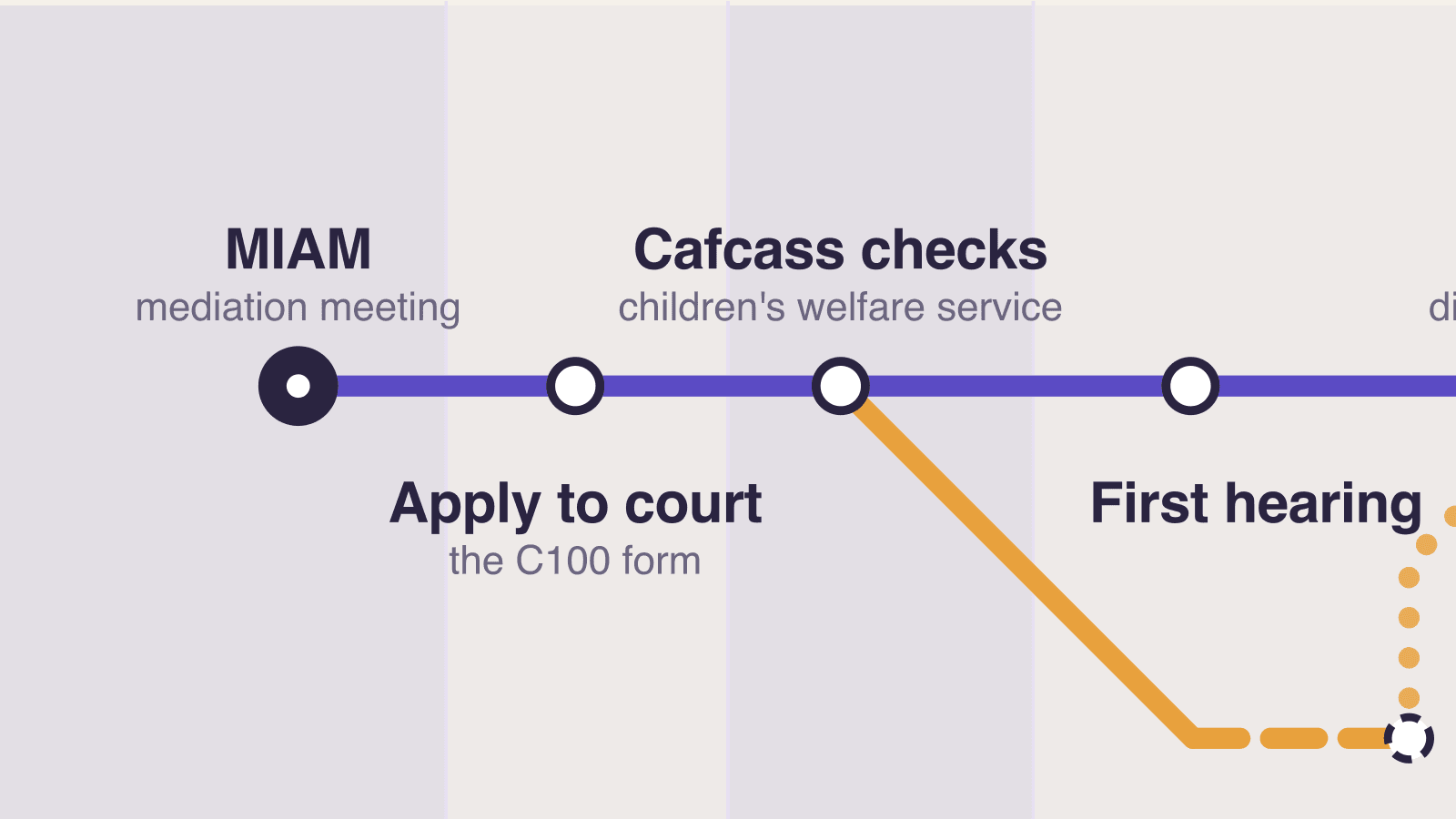
A letter from the family court can bring a wave of questions, and one of the first is often the simplest: do I actually have to go? This guide answers that in plain English, for parents in England and Wales, along with what to do if you cannot make a hearing or feel worried about being there.
The short version
- If you are a party to the case, you are expected to attend. That means the parent who applied (the applicant) and the parent or person responding (the respondent). Your notice of hearing tells you when, where and how.
- A hearing can go ahead without you. If you were properly told about it and do not attend, the court can carry on and make decisions in your absence.
- If you genuinely cannot attend, tell the court as soon as you can, in writing, with your reason and any evidence. Asking early gives the court the chance to move the hearing or let you join by phone or video.
- Many hearings are now remote or hybrid. Your notice says whether you attend in person, by video or by phone.
- If you feel unsafe, you can ask for support, such as a separate waiting room, screens, or joining remotely.
- Children do not usually attend. Their views normally reach the court through CafcassCafcass is the Children and Family Court Advisory and Support Service. It is independent of the court and of both parents, and its job is to advise the court about what is best for a child. (the Children and Family Court Advisory and Support Service).
Who is expected to attend
In a children case, the people named on the application are the parties. The parent who makes the application on the C100A C100 is the form you fill in to ask the family court to make a decision about arrangements for a child. Once the court issues it, your case has a number and a first hearing is normally listed. form is the applicant, and the other parent (and sometimes another person with parental responsibility) is the respondent. Each party is sent a notice telling them about each hearing.
If you are a party, attending is how you take part. It is where you can tell the court what you agree with, what you do not, and what you think would work for your child. The court sets the next steps at each hearing, often with deadlines for statements or documents, and those steps apply to you whether or not you were there to hear them.
Other people, such as a witness, only attend if the court asks them to.
What happens if you don't attend
The court's rules allow a hearing to go ahead in a party's absence, as long as the court is satisfied they were properly told about it. That means decisions about your child's arrangements, or about what happens next in the case, can be made without hearing from you.
If the applicant does not attend, the court has other options too, such as adjourning (postponing) the hearing or, in some cases, bringing the application to an end. Either way, missing a hearing usually means delay, and it means the court hears less about your child from you.
If you missed a hearing because something went wrong, contact the court as soon as you can. Explain what happened and ask what you need to do next.
If you can't attend: what to do
Life does not always fit around a court diary. If you have a genuine reason you cannot attend, such as illness, a hospital appointment or a childcare emergency:
- Contact the court as soon as you know, using the contact details on your notice of hearing
- Put it in writing and include your case number
- Explain clearly why you cannot attend
- Include evidence where you have it, such as a medical note or appointment letter
- Ask whether you could join by phone or video instead, or whether the hearing could be moved
- Let the other party know you have contacted the court, if it is safe to do so
- Keep a copy of everything you send
It is for the court to decide whether to move the hearing or how you can join. The earlier you ask, the more options there usually are.
Remote and hybrid hearings
Many family hearings in England and Wales now take place by video or phone, or with some people in the room and some joining remotely. Your notice of hearing says which. If it says in person and you have a good reason to need a remote option, you can ask the court in advance. If it says remote and you do not have a suitable device or a private space, tell the court before the hearing.
For a remote hearing, find a quiet, private room where children cannot hear, test your connection beforehand, and have your documents open and ready.
If you feel unsafe about attending
If you are worried about being in the same building or room as the other party, you can ask the court for support before the hearing. These are sometimes called participation directions, and they can include a separate waiting area, a separate entrance, screens in the courtroom, or joining by video.
Contact the court as early as you can and explain your concerns. If you are a victim of domestic abuse, the court's rules recognise that you may need this kind of support. If you are ever in immediate danger, call 999.
Do children have to go to family court?
Usually not. Children do not normally attend hearings about their arrangements. Their wishes and feelings usually reach the court through Cafcass, whose officers may speak to them, and in some cases through a fuller report. Occasionally an older child may meet the judge, but that is the court's decision and is not a common part of most cases.
Common questions
Do I legally have to attend family court?
If you are a party to the case, you are expected to attend each hearing you are told about. If you do not, the hearing can go ahead without you and decisions can be made in your absence. If you cannot attend, tell the court in writing as early as possible.
What happens if I don't go to my family court hearing?
The court can carry on without you if it is satisfied you were properly told about the hearing. That can mean decisions about your child's arrangements are made without hearing from you, and it often adds delay to the case.
Can I attend a family court hearing by video?
Many hearings are remote or hybrid already, and your notice says how you attend. If you need a remote option for a good reason, ask the court in writing before the hearing. It is the court's decision.
Do I have to go to court to sort out child arrangements at all?
No. Many parents agree arrangements without going to court, sometimes with the help of mediation. A MIAMA MIAM is a first meeting with a trained mediator, on your own, to talk about whether mediation could help sort things out without a court hearing. Most people have to attend one before applying to court, unless an exemption applies. (a Mediation Information and Assessment Meeting) is usually needed before applying, and it is a chance to see whether agreement is possible first.
Do I have to attend a divorce hearing?
Most divorces in England and Wales are dealt with online without a hearing. Hearings are more common where there is a dispute about money or children, which are separate applications.
Sources
- Family Procedure Rules 2010 (Ministry of Justice), including Part 3A on vulnerable parties and participation directions
- Children Act 1989, section 1 (legislation.gov.uk)
- What to expect coming to a court or tribunal (GOV.UK)
- Cafcass: for parents and carers (Cafcass)
How familycourt.app and McKenzie can help
McKenzie, the app's AI assistant, shows you where your case is on a plain-English map and explains what usually happens at the next hearing, using your own case facts. If you are getting ready to write to the court, it can help you work through what to include. Document Studio helps you prepare your own position statementA position statement is a short document, usually a page or two, telling the judge before a hearing where things stand for you and what you are asking the court to consider. It is not evidence, and it is yours: you decide every word in it. and chronology, so that whether you attend in person or by video, you have your information organised and ready.