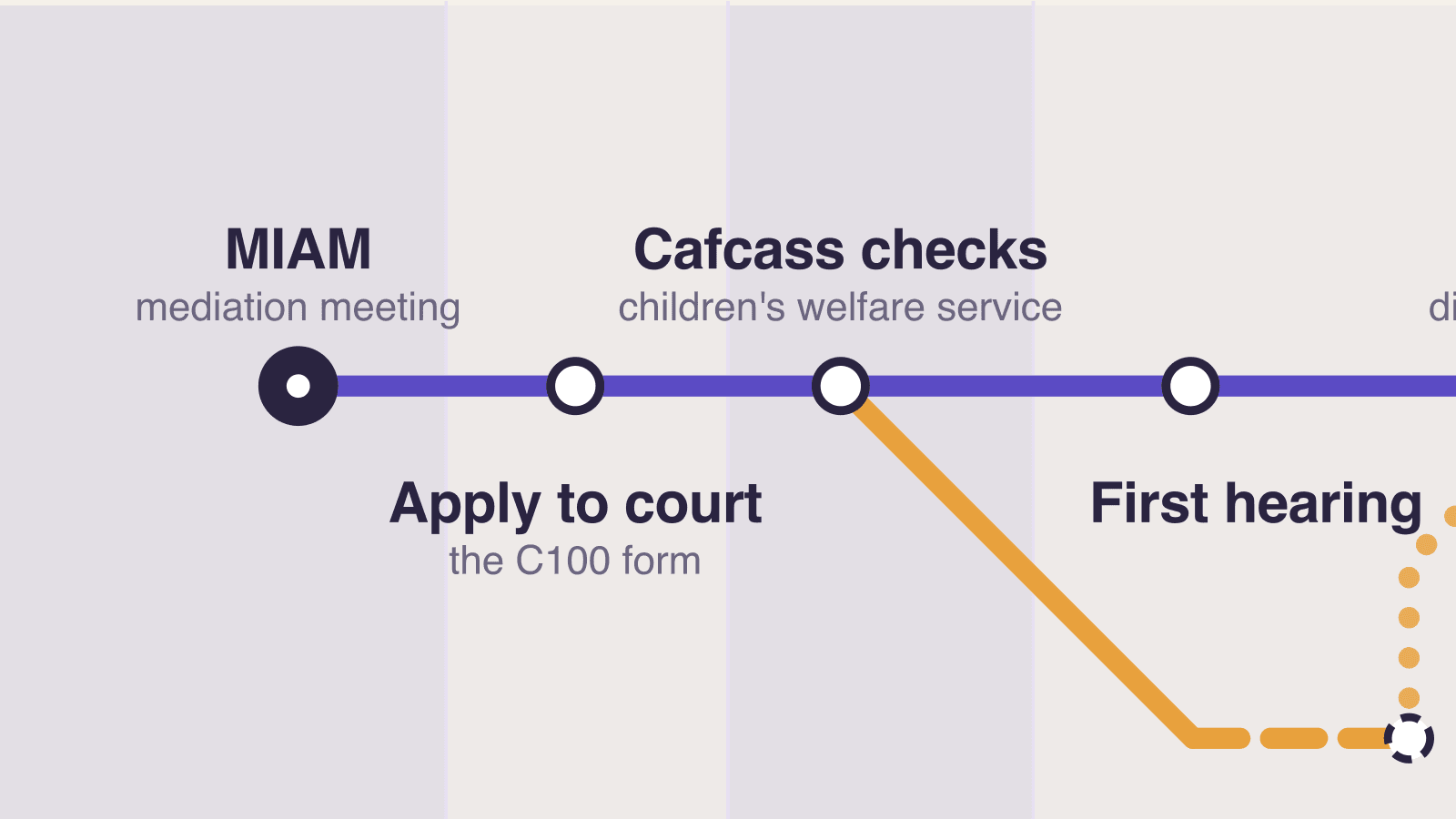
A child arrangements case has a handful of stops: the mediation meeting, the application, the first hearing, the Cafcass report, the dispute resolution hearing, the final hearing. Each one has a price, and so does the time in between. This is the cost map for a case in England and Wales in 2026, with or without lawyers. Every figure excludes VAT unless it says otherwise.
Before you read on. These are typical ranges built from the published price lists of family law firms and barristers' chambers in England and Wales, the court's own fee schedule and the 2026 guideline hourly rates. Your quote will differ. In children cases each side normally pays its own costs whatever the outcome, and nothing here is legal advice or a prediction about your case.
At a glance: £360 to £420 is the court fee and MIAMA MIAM is a first meeting with a trained mediator, on your own, to talk about whether mediation could help sort things out without a court hearing. Most people have to attend one before applying to court, unless an exemption applies. if you represent yourself, and less with Help with Fees. £7,700 to £18,600 plus VAT is the typical range for a solicitor and barrister to a one-day final hearing. £201 to £579 an hour is the spread of the 2026 guideline solicitor rates by grade and region. And 51% of private law cases in April to June 2026 had no lawyer on either side.
The cost map, stop by stop
This is the same route map that sits at the top of every case on familycourt.app, with a price attached to each stop and each stretch between stops. Pick how you would be represented and the figures change. The route is the standard one for a private law children case under the Child Arrangements Programme. In Child Focused Court areas (formerly Pathfinder) the stops differ a little, and there are usually fewer hearings. The solid lines are the usual path; the dotted ones are stops the court may or may not order.
Two things stand out. First, the price of a case is set less by the hearings than by the stretches between them: statements, correspondence and preparation are where the hours accumulate. Second, the gap between representing yourself and full representation is not £1,000 or £2,000. It is five figures, which is why more than half of parents now do this without a lawyer on either side. For how long each of these stops takes, and how that is changing, see Family court in 2026: how long it takes, what it costs and what is changing.
How the bill builds up
The same map as a running total. Each line is the midpoint of the ranges above, for a case that goes all the way to a one-day final hearing with no fact-finding hearing.
What you are paying for: 2026 hourly rates
Most solicitors charge by the hour, in six-minute units, and quote a fixed fee only for well-defined stages such as issuing the application. The courts publish guideline hourly rates that they use when deciding what costs are reasonable. From 1 January 2026 they are:
Per hour, excluding VAT. London 1 is the City and a few central postcodes; London 2 is the rest of central London; London 3 is outer London. National 1 covers most large cities and the South East; National 2 the rest of England and Wales. Source: Judiciary of England and Wales, Guideline hourly rates 2026.
Family firms are not bound by these rates and specialist firms often charge above them. The useful thing the table tells you is the shape of a bill: a letter that takes a Grade B solicitor outside London twenty minutes costs about £80 plus VAT; a day preparing for a final hearing costs £1,500 to £2,000 plus VAT before anyone sets foot in court.
Barristers charge differently. For a hearing they quote a brief fee, which covers preparation and the day in court, and a refresher for each further day. For a private law children case, published direct access fee sheets put a first hearing at £500 to £1,200 and a day of final hearing at £1,000 to £1,750 for a junior barrister, more for a senior one. All plus VAT.
Each stage in detail
Here is what sits behind each figure on the map. Timings are typical for a standard court and vary by area. All figures exclude VAT. Court fees are the same in every column. "Yourself + barrister" assumes you do the paperwork and instruct a direct access barrister only for hearings. The fact-finding row is a branch: it applies only where the court decides disputed allegations need a separate hearing.
Why the gaps cost as much as the hearings
Between the first hearing and the dispute resolution appointment there are usually three to four months. In that time CafcassCafcass is the Children and Family Court Advisory and Support Service. It is independent of the court and of both parents, and its job is to advise the court about what is best for a child. (the Children and Family Court Advisory and Support Service, which advises the court on children's welfare in England; Cafcass Cymru does the same in Wales) prepares its section 7 reportA section 7 report is a welfare report about what is best for a child, written for the court by Cafcass or the local authority when the court asks for one. It makes recommendations; the decision stays with the court., both parents file statements, and letters go back and forth. The report is free. The statements and the letters are not, if a solicitor writes them. A witness statement alone is commonly four to eight hours of a solicitor's time, which is where a £1,200 to £2,500 stretch of road comes from.
Estimate your own case
Choose the shape of your case to get a typical range. It is an estimate from published fee guides, not a quote, and a solicitor or barrister will give you their own costs information before you instruct them.
Where the money goes
Take the solicitor-plus-barrister case to a one-day final hearing, at the midpoint of the ranges: about £13,200 plus VAT. Split it by the kind of work being paid for and the picture is clearer than any hourly rate.
That is the point of the next chart. If you are one of the 51% doing this without a lawyer, the drafting, organising and understanding does not disappear. You do it. familycourt.app is built for exactly that part: it is built around family court procedure in England and Wales and helps you understand each stage, organise your evidence and prepare your own statements in the form the court expects. It does not speak for you in court and it does not give legal advice. The chart is honest about both.
Ways to get help, and what each costs
Representation is not all or nothing. Many parents mix these.
| Option | Typical cost | What it is |
|---|---|---|
| Legal aid | Free, if eligible | Mainly for people with evidence of domestic abuse or child abuse, and means-tested. 83% of applications through that route were granted in April to June 2026. Finding a provider is the hard part in many areas. |
| Support Through Court and law centres | Free | Volunteers who can help you prepare for and attend hearings, and local law centres offering free initial advice. Capacity is limited and varies by court. |
| One-off solicitor advice | £150 to £350 per session | Many firms offer a fixed-fee first meeting. Useful for a sense-check before you apply or before a hearing. |
| Unbundled solicitor work | £200 to £400 per hour | You instruct a solicitor for specific tasks only, such as reviewing your statement, and do the rest yourself. Ask whether the firm offers it; not all do. |
| Direct access barrister | £500 to £1,750 per hearing | You instruct a barrister directly for a hearing, without a solicitor. You handle the paperwork and correspondence. Works best if you are organised. |
| Trained McKenzie friend | £50 per session via familycourt.app | A non-lawyer who helps you prepare and can sit with you in court, but cannot speak for you or give legal advice. A 45-minute call with a written summary afterwards. |
| Solicitor throughout | £5,000 to £15,000 plus VAT | Full representation from application to final hearing, with the solicitor as advocate. Settling early is the single biggest saving. |
| Solicitor plus barrister | £7,700 to £18,600 plus VAT | The solicitor runs the case and briefs a barrister for hearings. Adds a day rate per hearing but gives you a specialist advocate. |
Keeping costs down
None of these change what the court does. They change how many hours a lawyer bills, or whether you need one for a given stage.
- Apply for Help with Fees before you pay the £270. Full remission is available to a single applicant with savings under about £4,250 and gross monthly income under about £1,420, with allowances for children. Check the current thresholds on GOV.UK.
- Use the mediation voucher. Up to £500 per family towards mediation about children, not means-tested, until at least March 2027. More than two-thirds of early users reached an agreement without going to court.
- Ask for fixed fees by stage and a written costs estimate at the start. Firms are required to give you costs information; ask what is and is not included, and what happens if the case runs on.
- Arrive prepared. A solicitor charges for reading your messages, so send a short, dated chronology and organised documents rather than a folder of screenshots. The same preparation is what makes a direct access barrister affordable, because you are not paying them to assemble the case.
- Do not pay for what Cafcass does for free. The safeguarding letter and the section 7 report are the court's evidence, not yours. You will want help understanding and responding to them, which is different from commissioning your own.
- Be realistic about the final hearing. Most cases settle at or before the DRAA DRA is a dispute resolution appointment: a hearing later in the case that looks at whether things can be settled now the reports and statements are in. If everything is agreed there, an order can be made at that hearing.. If yours can, the difference is roughly the cost of a small car.
Questions parents ask
How much does a family law solicitor cost per hour in 2026?
The 2026 guideline hourly rates range from £142 for a trainee outside London to £579 for a senior solicitor in central London, plus VAT. A typical family solicitor outside London charges £200 to £300 an hour. Firms set their own rates and are not bound by the guidelines.
How much does a child arrangements order cost with a solicitor?
From published price lists, a case that settles at the first hearing typically costs £750 to £2,000 plus VAT in solicitor fees. One that runs to a contested final hearing typically costs £5,000 to £15,000 plus VAT, and more if a barrister is instructed or there is a fact-finding hearing. The court fee is £270 on top.
How much does a barrister cost for family court?
For a private law children case, published direct access fee sheets put a first hearing or DRA at £500 to £1,200 and a one-day final hearing at £1,000 to £1,750 for a junior barrister, more for a senior one, all plus VAT. If a solicitor instructs the barrister, their fee is in addition to the solicitor's.
Can I use a barrister without a solicitor?
Yes. Under the public access (direct access) scheme you can instruct a barrister directly for advice or a hearing. You remain responsible for the paperwork, the court correspondence and filing documents on time. Not every barrister takes direct access work.
Will the other parent have to pay my costs?
In children cases the usual rule is that each side pays their own costs whatever the result. Costs orders are made only where someone's conduct of the case has been unreasonable. Budget on paying your own.
How much does it cost to represent yourself in family court?
The unavoidable costs are the £270 court fee (which Help with Fees can reduce or waive) and the MIAM, typically £90 to £150. Beyond that it costs your time. In April to June 2026, 51% of private law cases had no lawyer on either side.
Is the Cafcass report free?
Yes. Cafcass safeguarding checks and section 7 reports are prepared for the court at no charge to either parent. What costs money is paying a lawyer to help you respond to them.
Sources and notes
Stage ranges combine published fixed fees and estimates from family law firms and barristers' chambers with the 2026 guideline hourly rates. Where sources gave a single figure, a range was built around it using the hourly rates. Figures exclude VAT unless stated. They describe typical cases in England and Wales and will not match any individual quote.
- Judiciary of England and Wales, Guideline hourly rates 2026 (effective 1 January 2026)
- Ministry of Justice, Family Court Statistics Quarterly: April to June 2026 (representation figures)
- HMCTS fees from 13 July 2026, as summarised by Direct Mediation Services
- Family Mediation Council, cost of mediation and the voucher scheme
- QualitySolicitors Large and Gibson, Children Act proceedings cost guide
- Dicksons Solicitors, family fixed fees
- Kayson Law, fixed-fee family law
- Bank House Chambers, public access fee estimates, private law children
- DPF, fixed fees for Children Act applications
- Legal Aid Agency, Legal aid statistics: April to June 2026
- Family Mediation Voucher Scheme figures and extension to March 2027
How familycourt.app and McKenzie can help
Most of the bill is preparation, and that part you can do. familycourt.app helps you understand each stage of a children case in England and Wales, organise your evidence and prepare your own statements in the form the court expects, for £25 a month. McKenzie, the assistant inside it, walks through the route with your own case facts and explains what each stop involves. It is built around family court procedure. It is not a solicitor, it does not give legal advice and it cannot speak for you in court. If you decide you want a lawyer for one hearing, you will arrive with the work already done.